← All video-articles
Refinancing
Refinancing to 4%: Points, Closing Costs, and the Real Savings
A 15-year refinance case showing how discount points, financed closing costs, equity, payment savings, and break-even analysis work together.
Published
Refinancing
A 15-year refinance case showing how discount points, financed closing costs, equity, payment savings, and break-even analysis work together.
Published
Key points
An offer to “refinance your mortgage at 4%” can sound either miraculous or deceptive. A low note rate can be real when the borrower pays discount points, has enough equity to support the transaction, and the long-term savings justify the upfront cost.
This analysis uses an actual 15-year mortgage example:
This is one historical file, not a current quote. A refinance should be evaluated using the Loan Estimate, exact payoff, appraisal or waiver, discount points, break-even period, and the homeowner’s expected holding period.
Homeowners routinely receive mail and online advertising with unusually low rates. The fine print may reveal that:
The first useful question is not, “Does a 4% rate exist?” It is “What does that rate cost, and how long will it take to recover the cost?”
The borrower had taken out approximately $712,000 on a 15-year term. A shorter amortization produces a high monthly payment, but principal falls quickly. After roughly 11 months, the balance had declined to about $676,000.
That point matters. A borrower with a 30-year mortgage may reduce principal much more slowly during the first year, producing a different refinance calculation.
The original principal-and-interest payment was approximately $5,900. The borrower had already demonstrated the ability to carry that obligation but wanted to reduce the total cost of the debt.
The payoff of the existing mortgage was about $676,000. The new loan was approximately $697,000—roughly $21,000 higher.
That difference consisted of approximately:
The expenses did not disappear. They were financed through the property’s equity and added to the principal balance. That reduces the amount of cash due at closing but increases the new debt.
A proper comparison therefore considers more than the rate and payment. It also accounts for the financed costs and the fact that the borrower begins a new amortization schedule.
One discount point equals 1% of the loan amount. On a $697,000 loan, one point is $6,970.
Paying one point does not automatically reduce the interest rate by one percentage point. The rate impact is determined by the lender’s pricing on that date. One point might buy 0.125%, 0.25%, or a different amount.
In this file, approximately $18,000 represented about 2.6 points. That helped produce a 4% note rate, but the rate sheet was specific to the date, product, lock, and borrower profile.
There is no universal rule that every borrower may “buy no more than three points.” The transaction may be affected by Qualified Mortgage points-and-fees limits, high-cost mortgage thresholds, treatment of bona fide discount points, lender policy, and the particular loan type.
After refinancing, the principal-and-interest payment fell by approximately $714 per month.
If the borrower pays only the new minimum, household cash flow improves. If the borrower continues to send roughly the former $5,900 payment, the additional amount can reduce principal and shorten the effective payoff period.
That flexibility was one of the transaction’s strengths:
The borrower still needed to confirm that the new loan had no prepayment penalty and that additional payments would be applied to principal.
The analysis compared two future paths:
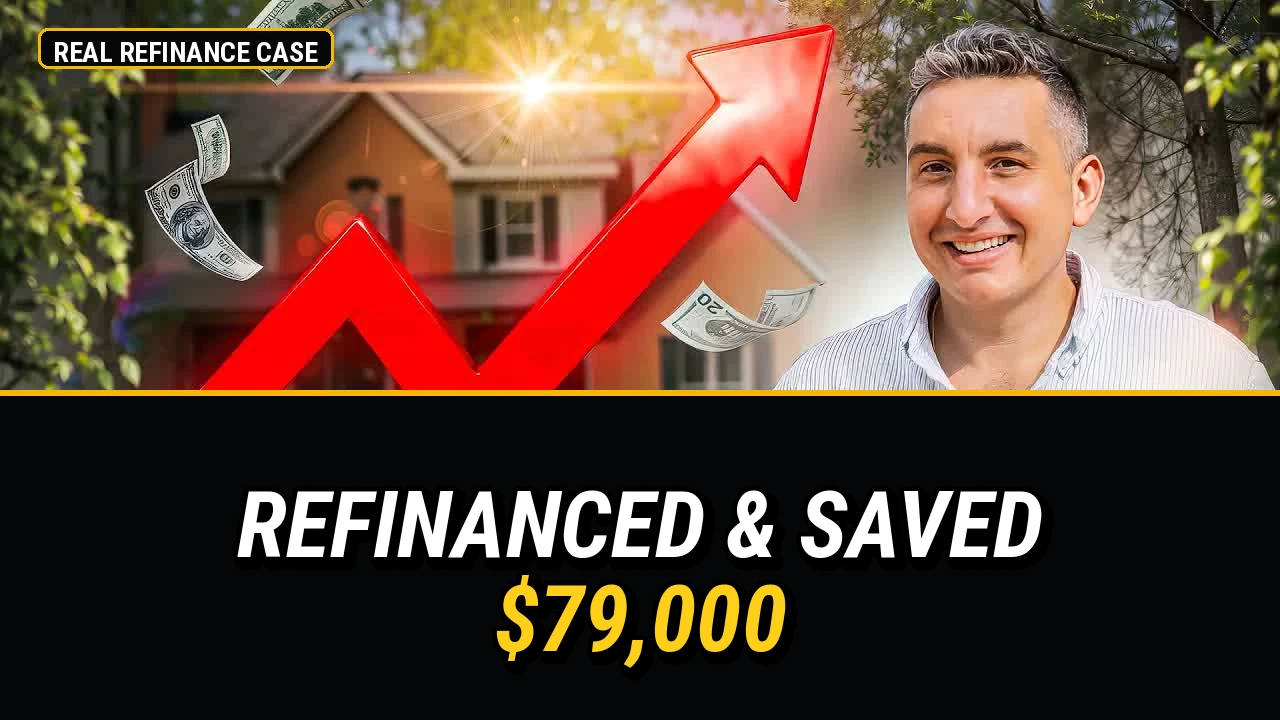
Although the principal increased by about $21,000, the lower rate produced projected remaining-interest savings of approximately $79,000.
That does not make every points-heavy refinance worthwhile. This result was supported by:
There are two useful ways to evaluate break-even.
If transaction costs are $21,000 and the monthly payment drops by $714:
$21,000 ÷ $714 ≈ 29 months.
That is only a rough measure. Some of the $21,000 is financed, the principal balances are different, and principal amortizes at different speeds under the two loans.
A more complete analysis compares, month by month:
For a large refinance, this month-by-month comparison is more useful than dividing costs by monthly savings alone.
When the property value and maximum permitted loan-to-value ratio leave sufficient room, a borrower may be able to include refinance costs in the new balance. The homeowner avoids paying the entire amount out of pocket, but gives up part of the existing equity.
Before deciding, review:
The phrase “no-cost refinance” usually means the costs are either added to the loan or offset by a lender credit tied to a higher rate. The costs do not cease to exist.
In a purchase, the buyer generally cannot raise the loan amount beyond the permitted loan-to-value ratio simply to finance any amount of points and costs. Possible funding sources include:
In a refinance, existing equity may allow costs to be added to the new balance when the program and loan-to-value limits permit it.
Not necessarily. A homeowner should compare several rate-and-cost combinations:
| Option | Typical tradeoff |
|---|---|
| No-points or low-cost option | Higher rate, lower upfront cost, faster break-even |
| Moderate buydown | Middle ground between payment and closing cost |
| Aggressive buydown | Lowest rate, high point cost, generally requires a long holding period |
| Lender-credit option | Higher rate, but the lender offsets part of the closing cost |
A homeowner expecting to sell in two years usually should not pay heavily for a rate with a five-year break-even period. A family expecting to keep the property and loan for 15 years may reasonably choose a more aggressive buydown.
The 4% rate in this file was real, but it was not free. The borrower financed approximately $21,000 in costs, increasing the balance from a payoff near $676,000 to a new loan near $697,000. In exchange, the principal-and-interest payment fell by about $714, and the projected interest savings were approximately $79,000.
The right refinance question is not simply “How much lower is the rate?” It is “What does the new structure cost, when does it reach break-even, and what balance will remain when I sell or pay the loan off?”
The payoff of the old mortgage was combined with financed discount points and other closing costs. The expenses were paid through equity rather than disappearing.
No. One point equals 1% of the loan amount. The rate improvement depends on market pricing and the lender’s rate sheet.
Start with closing costs divided by monthly savings, then compare the old and new balances, interest, principal, term, and expected sale date.
Usually the costs are added to the loan or offset by a lender credit tied to a higher rate. The transaction still has an economic cost.
Keep exploring