Lower entry prices
Statewide price levels can make down payment, reserve and payment goals more achievable than in coastal markets.
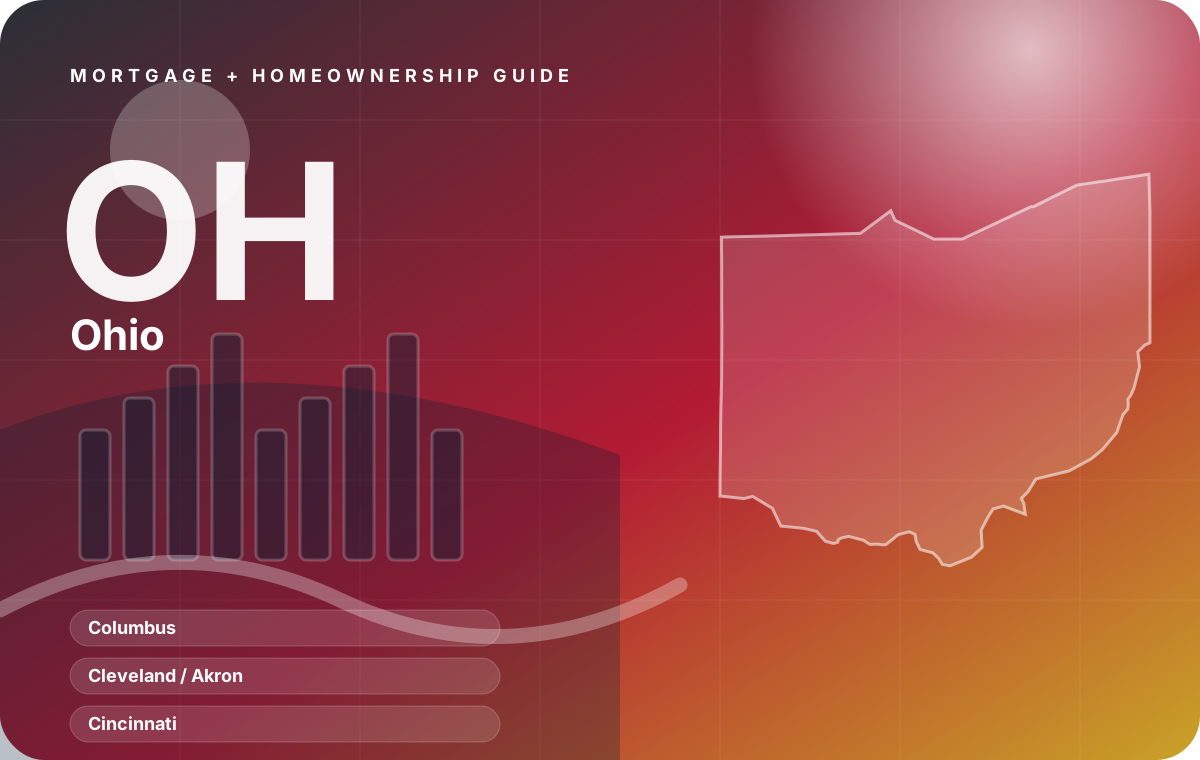
OH · Mortgage + homeownership guide
Columbus, Cleveland, Cincinnati, Dayton and regional markets offer lower statewide price levels than many licensed states, while homes can still move quickly and older properties need careful review.
Opportunity with discipline
Statewide price levels can make down payment, reserve and payment goals more achievable than in coastal markets.
Columbus, Cleveland and Cincinnati combine healthcare, education, finance, manufacturing and logistics.
Older housing stock can offer location and character when condition and renovation financing are evaluated correctly.
OHFA programs include mortgage, down-payment, professional and graduate-oriented pathways subject to current rules.
The same state can solve different problems
Choose the card closest to your situation. The mortgage path and the best submarket can change with the goal.
June 30, 2026
Directional statewide snapshot; address and submarket decide the transaction.
Source: Zillow Home Value IndexUse the map to compare six distinct mortgage and property contexts.
Pins are decision areas, not branch offices or service guarantees.
Compare structures, not product names
Availability and pricing vary by state, borrower, lender, property and current rules.
For documented W-2 or qualifying self-employed income; county limits and complete payment determine fit.
Government-backed routes can solve specific credit, military or eligible-rural needs; each has property and eligibility rules.
For larger loan amounts with stronger reserve, credit and documentation review.
For certain self-employed or nonstandard-income files; usually higher down payment, pricing and reserve requirements.
For actual investment property where rent and property economics support the loan—not a substitute for primary occupancy.
Can reduce cash or initial payment, but conditions, repayment, limits and permanent cost must be compared.
Protect the opportunity
These are not reasons to avoid the state. They are reasons to verify the address and financing earlier.
Roof, electrical, foundation, mechanical and health/safety items can affect insurance, appraisal and government-loan eligibility.
Match inspection findings to product standards before removing contingencies.
Statewide homes can move quickly even at lower prices, making a fully verified pre-approval valuable.
Complete document and funds review before touring seriously.
County, city, school district and reassessment can produce different payments at similar prices.
Use address-specific estimates, not a statewide percentage.
Some localities may have inspection, escrow or repair practices that affect timing/cash.
Ask the local realtor/title team immediately after identifying the city.
Small loan amounts can be less economical or outside some product/lender appetite.
Confirm loan amount, costs and available lender options before assuming every property is financeable.
A distressed home may not meet standard property requirements but could fit a renovation product.
Price repairs, contractor process, appraisal and timeline before contracting.
Official sources only
Programs can improve cash-to-close or payment, but funding, eligibility, repayment and lender participation must be checked live.
Thirty-year fixed conventional, FHA, VA and USDA-RD mortgage options for eligible low- and moderate-income first-time and repeat buyers.
Income, purchase price, credit, property and participating-lender rules apply; rates update regularly.
Official OHFA sourceCurrent OHFA materials describe assistance equal to 3% for conventional or 3.5% for government loans, usable for eligible down payment/closing costs and forgiven after seven years, subject to current rules.
Selling before forgiveness can require repayment; compare the assistance with the interest rate and full cost.
Current DPA structureOHFA options may provide rate or assistance benefits for eligible public-service professionals, military and recent graduates.
Occupation, graduation timing, residency, loan and program requirements must be confirmed in current OHFA guidance.
Targeted optionsNever treat an assistance figure, grant or reservation window as available until the official agency and participating lender confirm it for the current transaction.

How the state guide turns into action
Think in complete payment
This educational planner keeps tax, insurance, HOA and mortgage insurance visible. It is not a Loan Estimate, quote or approval.
Learn before the decision
Watch here or open the connected article for key takeaways and practical next steps.
Income, credit, funds and the property — translated into a borrower action plan.
Read the article →A clear orientation to the process, payment and lender review.
Read the article →What to review before a lender pull and why score alone never tells the full story.
Read the article →Compare the full structure — rate, points, credits, cash to close and time horizon.
Read the article →Current OHFA guidance describes 3% conventional or 3.5% government-loan assistance, generally forgiven after seven years if conditions are met. Verify the current guide, pricing and repayment triggers.
Current eligible occupations include specified military, public safety, healthcare and education roles. Exact employment and program requirements must be confirmed.
It can if it meets program property standards. Significant safety, condition or appraisal issues may need repair or a different financing route.
Lower price points and limited local inventory can create strong competition. A verified pre-approval helps the offer team move without guessing.
Possibly, but minimum loan size, costs, property condition and lender appetite can limit options. Confirm economics before contracting.
It finances an eligible purchase plus approved repair/improvement costs under a controlled process. Contractor, appraisal, draws and timelines are more involved than a standard loan.
We will separate what is known, what is estimated and what must be verified.